
How the Broadweigh Ecosystem Works: A Complete Guide to Smarter Load Monitoring
In last week’s post, we introduced the importance of load monitoring in modern rigging. This week, we’re going deeper... Breaking down how a full ecosystem like Broadweigh actually works.
Because the real power of Broadweigh isn’t just in a single load cell, it’s in how everything connects.
The Big Picture: A Fully Connected System
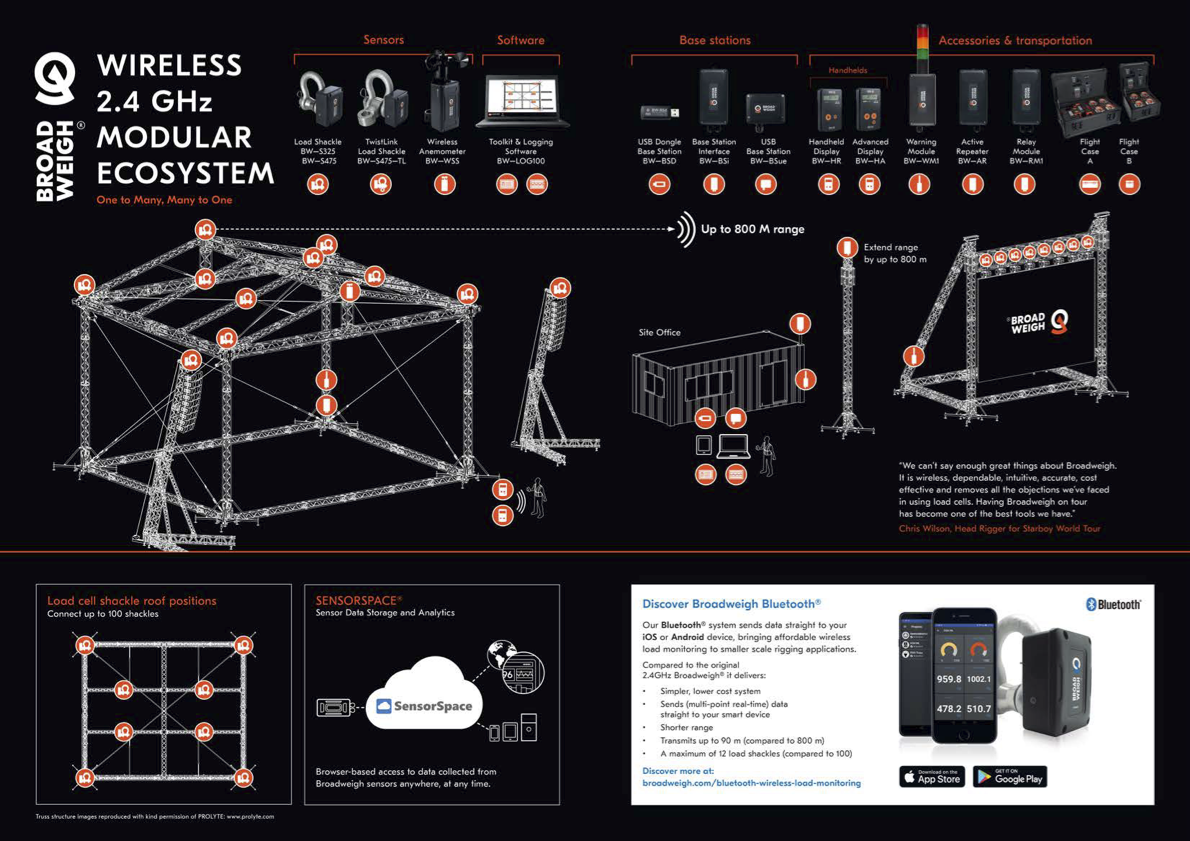
If you look at the ecosystem diagram (from the Broadweigh product overview), what stands out immediately is this:
Everything talks to everything.
From load shackles on the truss, all the way through to a laptop on site, the system is designed as a modular wireless network.
At its core, it follows a simple flow:
Sensors → Wireless Transmission → Base Stations → Displays & Software → Cloud (optional)
Let’s break that down.
1. Sensors: Where It All Starts
Every system begins with the sensors installed in the rigging.
These include:
- Load cell shackles (e.g. BW-S325/BW-S475)
- TwistLink shackles
- Wireless anemometers (wind speed monitoring)
Each sensor measures real-world force & load, tension, or environmental conditions, and converts that into digital data.
What’s important here is scale:
- Up to 100 load shackles can be connected in one system
- Positioned across roof structures, trusses, or ground supports
This gives a complete picture of what’s happening across the entire structure. Not just isolated points.
2. Wireless Communication: The Backbone
Once data is captured, it’s transmitted wirelessly using Broadweigh’s 2.4 GHz system.
This is where the ecosystem really comes alive:
- Data travels up to 800 metres between devices
- “One-to-many, many-to-one” communication structure
- No complex cabling across site
If needed, the system can be extended using:
- Active Repeaters (BW-AR) → Boost signal across large venues
- Relay Modules (BW-RM1) → Improve connectivity in complex environments
This means whether you’re in an arena, outdoor festival, or temporary structure, you can maintain stable, real-time communication.
3. Base Stations: The Control Hub
All wireless data is received by base stations, which act as the system’s central hub.
Examples include:
- USB Base Station (BW-BSue)
- Dongle Base Station (BW-BSD)
- Base Station Interface (BW-BSi)
These units collect signals from every sensor and feed them into the monitoring system.
Think of them as the bridge between physical rigging and digital control.
4. Displays & Monitoring: Real-Time Decision Making
Once the data reaches the system, it needs to be usable.
Broadweigh offers multiple ways to view and act on the information:
- Handheld Displays (BW-HR) → On-the-ground monitoring
- Advanced Displays (BW-HA) → More detailed system control
- Warning Modules (BW-WM1) → Visual alerts for overloads
This allows different team members (riggers, supervisors, engineers etc.) to all access the data in real time.
No delays. No guesswork.
5. Software & Cloud: From Data to Insight
Beyond live monitoring, the ecosystem also includes:
- Toolkit & Logging Software (BW-LOG100)
- SENSORSPACE® cloud platform
This unlocks:
- Data logging and reporting
- Remote access via browser
- Long-term analytics and compliance tracking
In practical terms, you can:
- Review loads after an event
- Prove compliance
- Improve future rigging setups
6. Bluetooth Option: Simpler, Smaller Setups
For smaller-scale jobs, Broadweigh also offers a Bluetooth-based system.
Key differences:
- Range up to 90 metres
- Up to 12 load shackles
- Direct connection to iOS/Android devices
It’s a lower-cost, simplified version, but still incredibly powerful for tighter environments.
Why This Ecosystem Matters
The real takeaway here isn’t just the individual components, it’s how they work together.
This system gives you:
- Full visibility across an entire rig
- Real-time safety monitoring
- Scalable setups (from small gigs to major tours)
- Reduced setup time (no cabling headaches)
It turns rigging from something you calculate once into something you can monitor continuously.
Final Thoughts
The Broadweigh ecosystem is a perfect example of where the rigging industry is heading:
Connected. Wireless. Data-driven.
For companies looking to improve safety, efficiency, and professionalism, understanding systems like this isn’t optional anymore, it’s essential.
In future posts, we’ll break down how to choose the right load monitoring setup depending on your job, budget, and scale. Keep your eyes peeled.
Anthony Chapman
Show Weight Solutions
Precision. Safety. Confidence.